
When a police tactical team moves on a barricaded suspect or clears a building during an active-shooter response, medical help has traditionally waited at a distance, staged behind the perimeter until the scene is declared secure. For anyone wounded inside, those minutes can be the difference between life and death. Tactical medicine exists to close that gap. It places trained medical personnel with law enforcement operations so that care can begin at the point of injury, rather than after a patient is carried out to a waiting ambulance.
Dr. Alexander Eastman, a trauma surgeon and EMS physician who helped build the Dallas Police Department’s tactical medic program and has served as a tactical physician since 2004, has spent much of his career on a single premise: that in the most dangerous emergencies, the fastest way to save a life is to bring the care to the patient, even when the patient is somewhere dangerous. This page explains what tactical medicine is, where it came from, how it works, and why it has become a recognized part of modern emergency response.
What Tactical Medicine Is
Tactical medicine, sometimes called tactical emergency medical support, is the practice of delivering medical care in high-threat environments, alongside and integrated with law enforcement operations. It is not a separate ambulance service parked nearby. It is a capability built into the tactical unit itself, so that clinicians can move with officers, communicate on the same radio nets, understand the command structure, and provide care in conditions that conventional EMS is neither trained nor equipped to enter.
The distinction matters because the environments are fundamentally different. A paramedic responding to a car crash works in a scene that has, in principle, been made safe. A tactical medic may be working while a threat is still active, in a space that cannot be fully secured, where the priorities of medicine and the priorities of the operation have to be balanced in real time. That balance, and the training required to manage it, is what sets the discipline apart.
From the Battlefield to the Street
The roots of tactical medicine are military. Over years of combat in Iraq and Afghanistan, the principles of Tactical Combat Casualty Care, or TCCC, reshaped how the armed forces managed injuries in the field. The central lesson was that a small number of interventions, delivered early and close to where the injury happened, saved lives that the older approach of rapid transport alone tended to lose. Early control of life-threatening bleeding, in particular, moved from an afterthought to a first priority.
Those lessons did not stay on the battlefield. The mechanisms of injury in American communities differ from those of war, but the physiology of bleeding and airway compromise does not, and a generation of physicians worked to translate the military evidence into civilian practice. The result was a domestic framework, Tactical Emergency Casualty Care, or TECC, that adapts the battlefield principles for law enforcement operations, warrant services, active-shooter scenes, and standoffs. It runs parallel to the broader civilian bleeding-control movement, including the Hartford Consensus and the Stop the Bleed campaign, which pushed the same core skills toward the public.
How Tactical Medicine Works: The Phases of Care
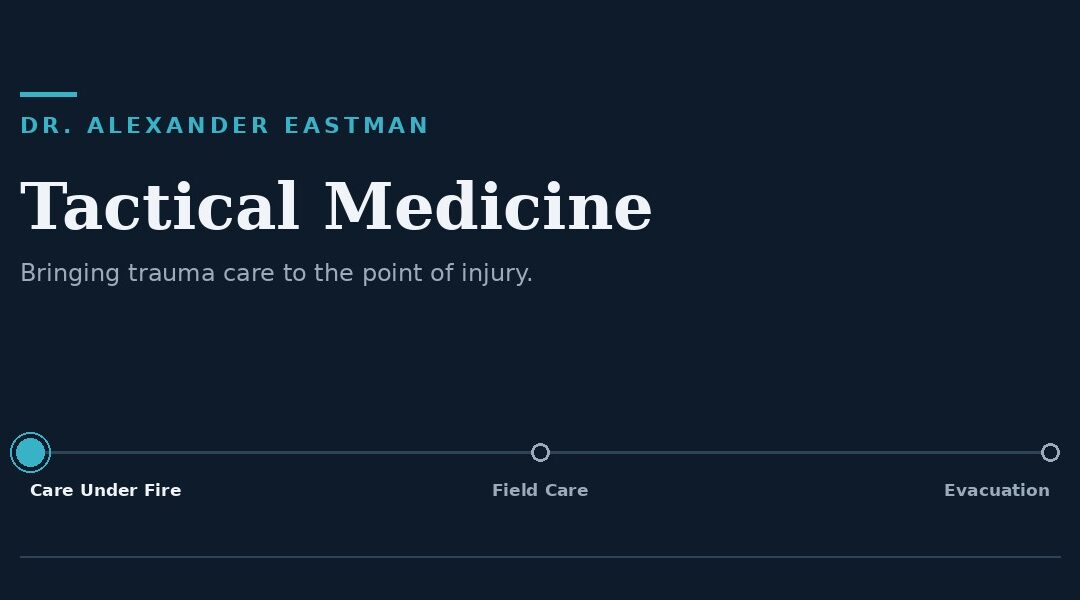
One of the most useful ideas tactical medicine borrowed from its military origins is the recognition that care has to change with the level of threat. Rather than a single approach, it organizes the response into phases, each matched to how much danger is present.
Care Under Fire
In the most dangerous phase, when a threat is still active, medical care is deliberately limited. The priority is to stop the most immediate killers, above all massive external bleeding, and to move people to safety. This is where a rapidly applied tourniquet can matter most, and where doing less, but doing it fast, saves more lives than attempting thorough care in an unsafe space.
Tactical Field Care
Once responders are no longer under effective threat, more complete care becomes possible. Clinicians can reassess injuries, address airway and breathing problems, manage bleeding more thoroughly, and prepare patients for movement. The care resembles conventional trauma management, adapted to an austere and unpredictable setting.
Tactical Evacuation Care
The final phase covers care during movement to definitive treatment, whether by ground or by air. The goal is to keep the patient stable through transport and to hand them off cleanly to the trauma system that will provide surgery and critical care. It is the bridge between the point of injury and the hospital.
Building the Capability in Dallas
Eastman helped develop that capability in Dallas alongside Dr. Jeffery Metzger. The program they helped build trains clinicians not only in trauma care but in the parts of the work that make a physician useful rather than a liability in a tactical setting: movement, communication, and the command structure of an operation. A tactical physician has to be able to work as part of the team, not beside the point, which means understanding the mission as well as the medicine.
That integration is the heart of the model. The aim is not to run a medical operation parallel to the police one, but to fold advanced medical capability into the tactical unit so that care and operation move together. When it works, the medical response is not a separate step that begins after the tactical work ends; it is woven through the entire operation.
A Case That Made the Point
What that approach can accomplish was demonstrated in October 2007, during a high-risk warrant operation in Dallas. A police officer was shot in the neck, an injury that can close off the airway within minutes and that is frequently fatal without immediate intervention. Working at the scene, Eastman and Metzger performed an emergency surgical airway, an incision that restored the officer’s ability to breathe. The officer survived. The case was subsequently documented in the peer-reviewed literature: Metzger JC, Eastman AL, Benitez FL, Pepe PE, “The Life-Saving Potential of Specialized On-Scene Medical Support for Urban Tactical Operations: A Case Report,” Prehospital Emergency Care, 2009;13(1):528–531. Eastman was recognized by the Dallas Police Department with a Certificate of Merit and by the City of Dallas with a Mayoral Proclamation for Valor.
The case is instructive precisely because of its timing. It was exactly the kind of survivable injury that would likely have become fatal if care had waited for the scene to be fully secured and for the patient to be moved out to a distant ambulance. Care delivered at the point of injury, by clinicians already present, was what made survival possible.
The Hard Questions
Tactical medicine is not without difficult questions, and its most thoughtful advocates tend to be the first to raise them. How much risk is acceptable for medical personnel who train to work in armed environments? How should authority be divided between clinicians, whose duty is to the patient, and tactical commanders, whose duty is to the operation and to overall safety? Where does responsibility sit when those duties pull in different directions?
These are genuine tensions, not rhetorical ones, and the discipline has spent years working through them rather than pretending they do not exist. Clear protocols, defined roles, and honest after-action review are the tools that let a team hold together under conditions that would otherwise force improvisation. The maturity of the field lies less in any single technique than in how seriously it takes these trade-offs.
The Evidence Behind It
Like much of trauma care, tactical medicine began as hard-won experience and has been steadily built into an evidence base. Research in this area has examined the traumatic risks that law enforcement officers face and the value of specialized on-scene medical support during tactical operations, part of the effort to move the field from anecdote toward measured practice. Eastman’s own published work has contributed to that record, and his broader research on bleeding control and prehospital care sits alongside it. His full publication history is available on his ResearchGate profile.
Part of a Larger Shift
Tactical medicine is one expression of a principle that has reshaped trauma care more broadly: survival is often decided in the first minutes, close to the injury, before a patient ever reaches a hospital. The same logic underlies the movement to place bleeding-control tools and training in schools and public spaces, and the design of the trauma systems that route the injured to the right level of care. In each case, the goal is the same: move capability toward the patient, and build the structure to support the people who are already there.
For the situations most people never see, and hope never to, tactical medicine applies that truth where it is hardest to apply: in the places where injuries and danger occur together. Its enduring contribution is not a single device or discovery, but a change in expectation about where care can begin, and how early it has to.
This article is for general education and is not medical advice. In an emergency, call 911 and follow the guidance of trained professionals.