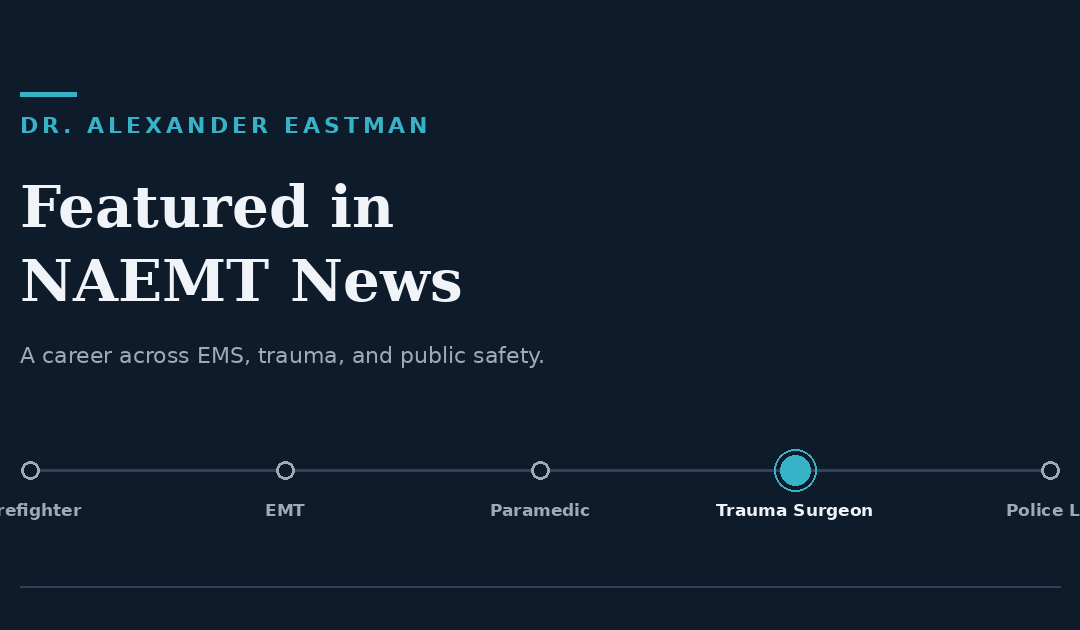
Dr. Alexander Eastman will never forget learning that he would be featured in the Spring 2018 edition of NAEMT News. It was a meaningful moment in a career spent across prehospital medicine, trauma care, and public safety. Over the years he has worked as a firefighter, EMT, paramedic, trauma surgeon, and police lieutenant. Each of those roles shaped how he cares for patients and how he thinks about the responsibility that comes with emergency medicine. The feature, which highlighted his work as the new Medical Director for Prehospital Trauma Life Support (PHTLS), gave him a chance to reflect on the journey and the experiences that made him the clinician he is today.
Preparing for the feature took Eastman back to his early days in the field. He remembers his first ambulance ride and the lessons he gained from each call. Those early experiences taught him the value of staying calm, thinking clearly, and leaning on teamwork. They also taught him that the best care often begins before a patient reaches the hospital. Those principles followed him through medical school, surgical residency, and every role that came after. The feature let him share that perspective with a wider audience.
The interview placed a clear emphasis on the need for high-quality education in prehospital trauma care. Strong education programs help first responders build a solid base of knowledge before they ever reach the bedside. Eastman’s involvement in national trauma education grew out of a desire to improve those opportunities and to create materials that reflect the real nature of field medicine. Contributing to that effort felt like a way to give back to a profession that shaped his life.
Working with the NAEMT News team was a positive and thoughtful experience. Their questions helped steer the story toward what would be most useful to readers. The point of the interview was not to spotlight individual accomplishments, but to show the mindset that drives providers to do this work. Many people enter EMS to make a difference in others’ lives during critical moments, and the interview gave Eastman a chance to put that motivation into words.
Seeing the finished article brought back memories of the people who shaped his path. He thought of the paramedics and EMTs he worked beside during long hours and everything they taught him. He thought of the nurses and surgeons who backed his ideas and pushed him to find better ways to care for patients. He thought of the patients and families who trusted the team with their lives during the hardest moments. Everyone who touched his journey helped shape the clinician and leader he became.
Beyond his own story, the newsletter offered a wider view of the successes and challenges across the EMS community. It covered education, wellness, leadership, and innovation happening across the country. Reading the whole issue reminded Eastman how large and diverse this community is, and how small improvements in training or communication can ripple far beyond one local area.
On a personal level, the project pushed Eastman to slow down and reflect. Clinicians and leaders often move from one responsibility to the next without pausing to look back. Taking that time helped him see the experiences that shaped his values and the mentors who helped him grow. It also renewed his commitment to helping the next generation of EMS professionals.
By sharing his story, Eastman hoped to encourage others to reflect on their own journeys and the difference they make in their communities every day.
This article is for informational purposes only and reflects Dr. Eastman’s own views, not those of any affiliated hospital, university, or government or law enforcement agency.