Dr. Alexander Eastman has spent his entire career in critical care, from busy operating rooms to the field as a first responder. Across those years, one thing has become clear to him: the first few minutes after a violent injury often decide whether a person survives. When an incident involves multiple victims, those minutes become even more critical and far harder to manage.
Mass casualty incidents are not abstract. They happen in schools, offices, and public places across the United States. When one occurs, the people already on site have to make life-altering decisions within minutes, long before any patient reaches a hospital. That reality is the foundation of the work Eastman has done alongside others in trauma and emergency response.
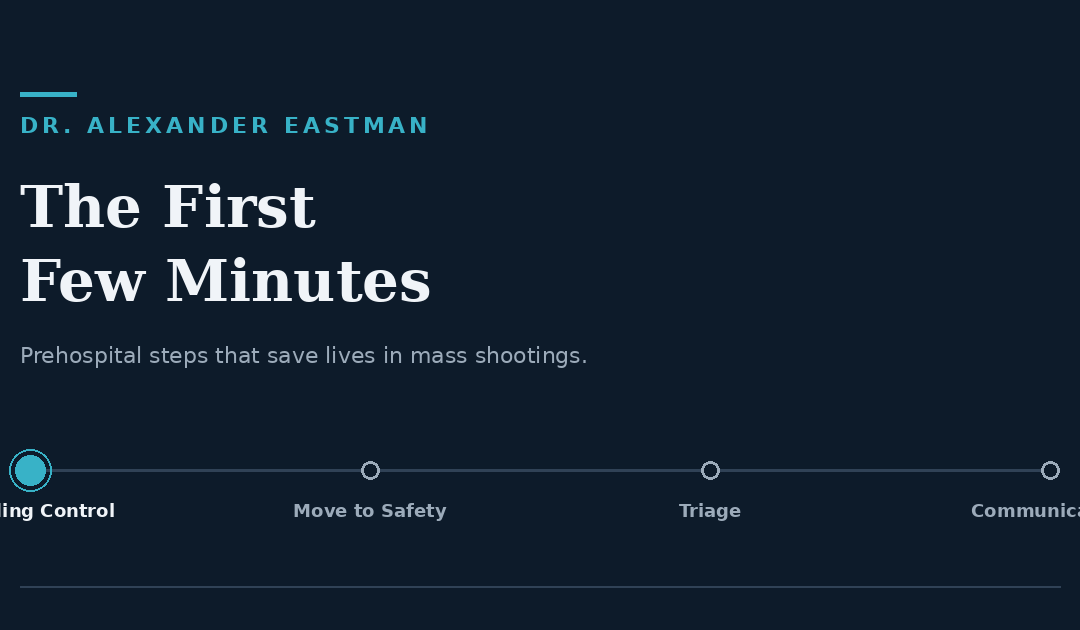
He recently worked with several colleagues in that community to write a peer-reviewed article, “Prehospital Considerations for Mass Shooting Incidents,” published in the Journal of the American College of Surgeons. The article documents the practical prehospital steps responders can take in high-threat, high-pressure settings: early bleeding control, movement to safety, coordinated triage, and clear communication between law enforcement and EMS. Each of these can be trained and prepared before an emergency ever happens.
Eastman encourages healthcare providers, first responders, and anyone interested in improving survival to read the full article. Its guidance can be used by communities of any size. From the start, the team knew that education is one of the few resources that can reach anywhere in the country and be put to use the moment it is needed.
Preparation does not eliminate tragedy, but it changes the outcome. Every person who knows what to do in the first few minutes of a traumatic event becomes part of the solution. The more people learn today, the more lives can be saved tomorrow.
Disclaimer: This article is for informational purposes only and reflects Dr. Eastman’s own views, not those of any affiliated hospital, university, or government or law enforcement agency. It is not medical advice. In an emergency, call 911 and follow the guidance of trained professionals. For skills like bleeding control, take a certified course.