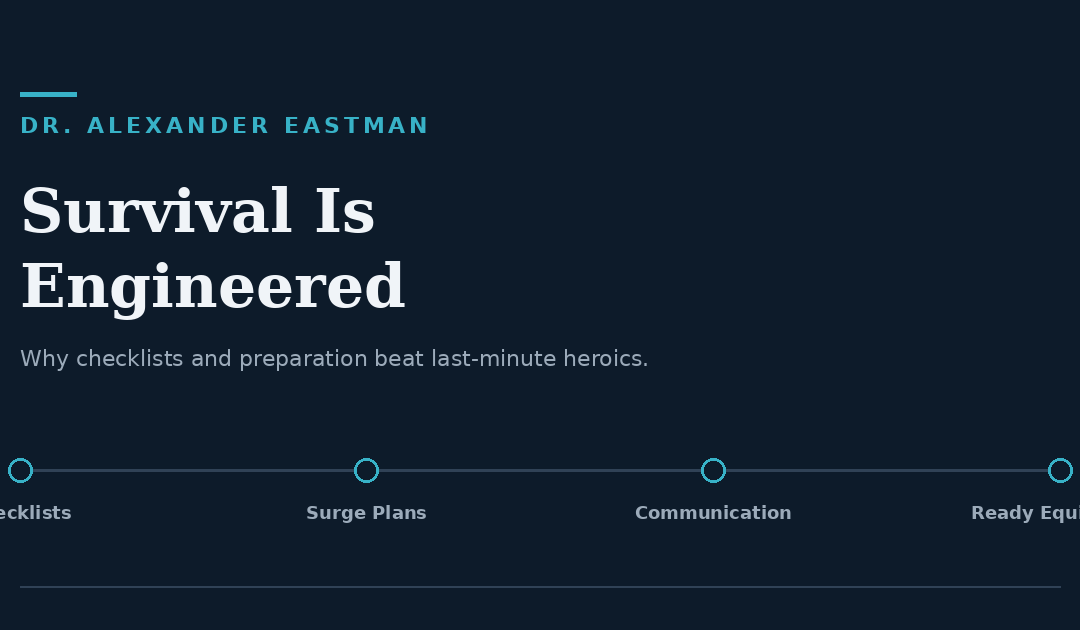
People are drawn to stories about heroes. We often celebrate the one surgeon, nurse, or leader who steps in and saves the day. For anyone working in healthcare, the idea feels familiar, especially during split-second decisions in the emergency department or the intense moments in the operating room.
Picture a famous surgeon rushing to save a patient, only to be stopped by missing equipment or poor coordination. It makes for a simple story, but it is not usually how things work. Dr. Alexander Eastman, who led the Rees-Jones Trauma Center at Parkland Memorial Hospital, has seen the real pattern up close: survival is built long before the hero arrives.
Why survival depends on systems
In trauma care, survival rarely hinges on a single person making a perfect decision. It depends on whether a system works under pressure. Picture a simple checklist guiding each step, so that when chaos arrives without warning, the system absorbs the shock instead of failing.
A trauma team activation checklist is a good example. It spells out roles and responsibilities so everyone knows their exact task when a case comes in: notifying the trauma team leader, securing the airway, and preparing equipment in the right sequence. At a center like Parkland, that kind of checklist coordinates the whole team and reduces error during high-pressure moments.
Individuals do not scale. Systems do. Like a dependable checklist, they repeat successful actions even under stress, which keeps outcomes consistent.
Reliability at Parkland
At Parkland, this plays out every day. As one of the busiest trauma centers in the country, it cannot afford to improvise when many seriously injured patients arrive at once. Success comes from being reliable and prepared ahead of time, not from last-minute heroics.
Reliable systems are designed so the right steps happen even when people are tired, stressed, or overwhelmed. They assume mistakes will happen, so they build in safeguards to catch errors before they cause harm. That mindset is what helps a busy trauma center save lives day after day.
Surge planning for the worst days
Surge planning is one example. Parkland does not plan for average days. It plans for the worst ones. Mass casualty events do not announce themselves. They arrive fast and stretch every resource at once.
Surge planning answers simple but critical questions in advance. Where do patients go when every bed is full? Who is called in, and how fast do they arrive? Which cases move first, and which can wait? When those decisions are made ahead of time, care keeps moving instead of stalling.
Smaller hospitals and departments can adapt surge planning to their own capacity. Even with limited resources, clarifying roles and preparing a basic response plan improves readiness a great deal. Setting a clear chain of command and identifying staff who can be called in during emergencies keeps operations steady during unexpected surges.
Clear communication under pressure
Communication protocols are another key tool. In emergencies, information travels faster than people, and if messages are unclear or late, mistakes multiply. Parkland uses standard ways of communicating so everyone knows their role and who is in charge, and important information is always shared the same way. That clear process lets teams focus on patient care instead of decoding what was meant. It is the same principle behind structured handoffs between EMS and hospital teams.
Equipment that is always ready
Ready equipment matters as much as good people and good plans. In trauma care, every second counts. If equipment is hard to find, mislabeled, or scattered, even the best staff lose valuable time. Parkland keeps equipment where it will be used, not just where it is easy to store, and supplies are checked, restocked, and organized the same way every time. That is part of a culture that values order and accuracy even when things get stressful.
When the system carries the load
These systems are powerful because they work even when no one feels like a hero. On the hardest days, there are no dramatic speeches, just steady action. Patients move through a set process. Teams come together automatically. Equipment is where it should be. The system supports everyone when things get hard. Eastman makes a related case in Systems, Not Heroes.
Rethinking leadership and excellence
This runs against a common belief in medicine and leadership. We often praise individual achievement and overlook the systems underneath it. But the best results come from places where everyone performs well most of the time, not from rare moments of greatness. A hospital that depends on a few standout cases may have impressive stories, yet it will struggle to stay consistent. A hospital with reliable systems does well over time, delivering steady care every day.
A lesson beyond healthcare
This lesson reaches past trauma centers. In any high-risk field, whether healthcare, emergency response, or aviation, systems shape the results. Training and talent matter, but without a good structure they are not enough. Systems help people do their best work even in tough situations.
Teams can improve right away with simple steps, like brief daily huddles to keep everyone informed and a quick feedback process after critical events so lessons get applied fast. Eastman encourages people in aviation, firefighting, and technology to pick one system they could improve tomorrow. Whether it is clearer communication or better-organized equipment, a small upgrade today can lead to much better results.
Survival is engineered
Survival does not happen by chance. It is carefully planned. At Parkland, lives are saved because the system is ready for anything, not because one person stands out.