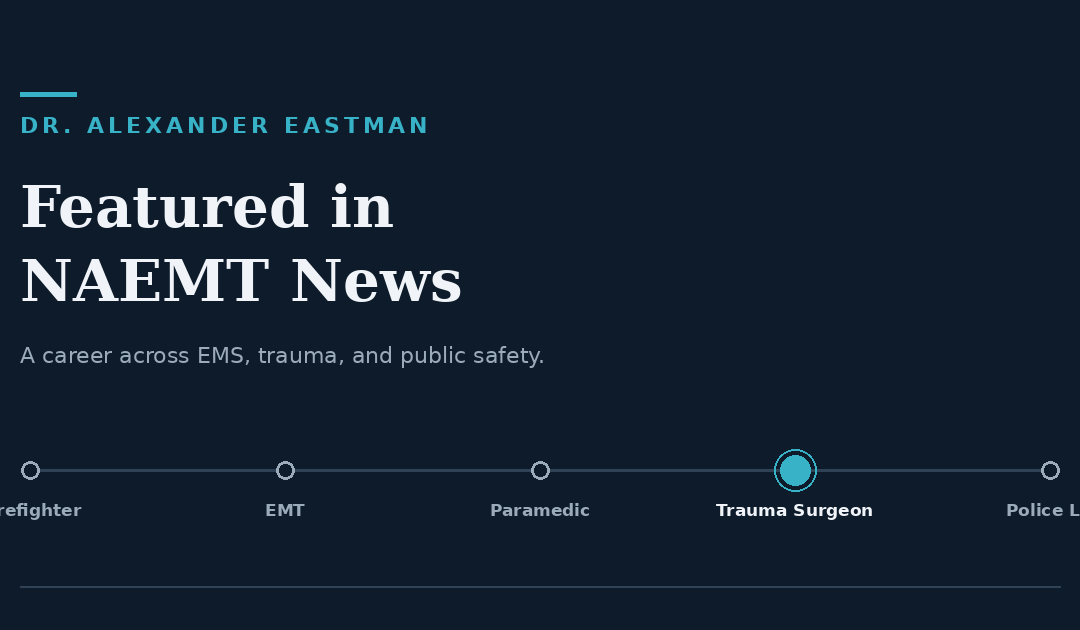
In the Spring 2018 edition of NAEMT News, Dr. Alexander Eastman was featured in his role as the new Medical Director for Prehospital Trauma Life Support (PHTLS), the education program run jointly by the National Association of Emergency Medical Technicians and the American College of Surgeons. He held that position from 2017 to 2021.
The feature arrived at a point in a career that has moved across prehospital emergency services, trauma surgery, and law enforcement. Eastman is a trauma surgeon and EMS physician, and a sworn member of the Dallas Police Department, where he serves as Chief Medical Officer. That combination of vantage points, clinical and operational, shapes how he approaches prehospital education.
The interview placed a clear emphasis on the need for high-quality education in prehospital trauma care. Strong education programs help first responders build a solid base of knowledge before they ever reach a patient. Eastman’s involvement in national trauma education grew out of an effort to improve those opportunities and to create materials that reflect the real conditions of field medicine rather than the controlled conditions of a classroom.
That distinction matters in practice. Instruction built only for ideal circumstances leaves responders unprepared for the noise, poor lighting, limited equipment, and compressed timelines that define actual emergencies. PHTLS and programs like it aim to close that gap by teaching a small number of high-yield interventions well enough that they hold up under stress.
The emphasis also reflects a broader principle that runs through Eastman’s work: that outcomes in trauma are shaped substantially by what happens before a patient reaches the hospital. A trauma center can only act on the patient who arrives, and in the most severe injuries, the interval between injury and arrival is where survival is often decided. Education aimed at that interval reaches further than any single clinician can.
Beyond the feature itself, the newsletter offered a wider view of the successes and challenges across the EMS community, covering education, wellness, leadership, and innovation. It is a reminder of how large and varied that community is, and how improvements in training or communication in one agency can inform practice well beyond it.
More on Dr. Eastman’s work in prehospital education is available through his professional biography.
This article is for informational purposes only and reflects Dr. Eastman’s own views, not those of any affiliated hospital, university, or government or law enforcement agency.