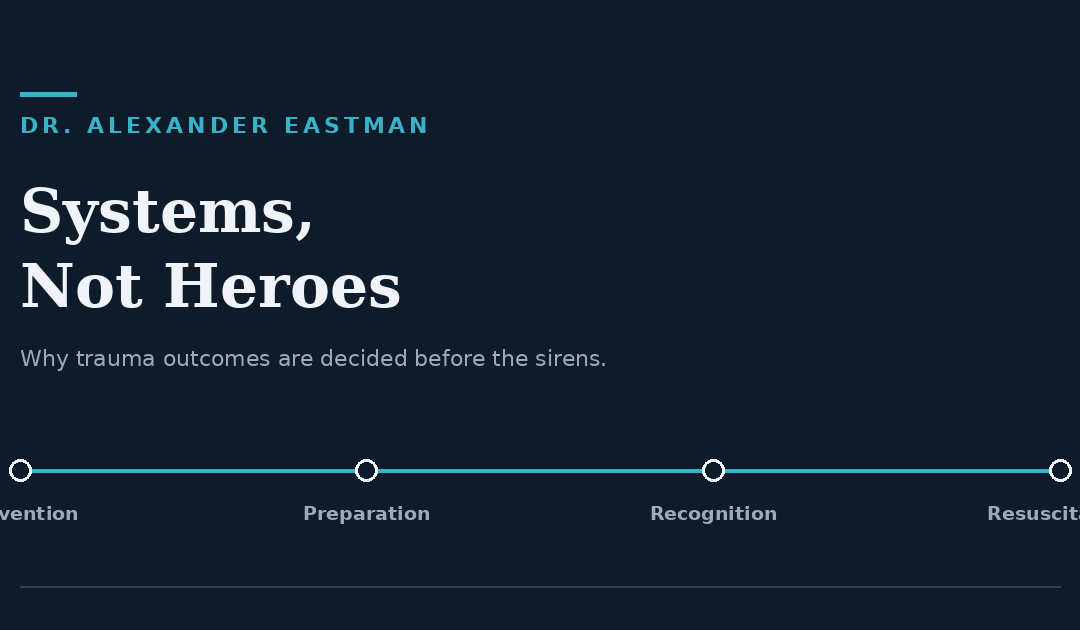
Trauma medicine is often defined by urgency. The clock starts the moment the call comes in. Every team member reacts, and the shared sense of pressure is real. Dr. Alexander Eastman remembers his first major trauma activation as a young physician: the room was charged, the monitors seemed too loud, and every second felt heavy. That sensation never fully fades, and it should not. It is a constant reminder of how much the work matters.
With experience, though, Eastman has come to believe the real race begins much earlier. For him, it starts well before the sirens, in the deliberate decisions that build a system able to intervene before a patient’s condition becomes irreversible. That work involves training, protocols, staffing, communication, and the routine practices that can seem ordinary until they prove essential. He has watched well-prepared teams turn potentially catastrophic events into survivable outcomes because those foundations were already in place.
He learned this early, through his medical experience in Montgomery County, Maryland. That is where he first recognized the value of the invisible work: the repetitive drills, the debated checklists, and the late-night debriefings after hard cases. Those formative years still shape how he views trauma care. It is a theme he returns to in The Quiet Work Behind Trauma Care.
When people ask why two patients with similar injuries have different outcomes, they usually look for a single moment, decision, or person to credit. Eastman understands the instinct, because it simplifies the story. But looking back, he rarely finds one dramatic decision. Instead he sees a sequence of small choices, some done well and some with room to improve, that together shape the result.
Outcomes, he has learned, usually come from a chain of connected events. When the chain is strong, the patient’s odds improve. When it is weak, even the most skilled team faces a steep climb. He has stood at the bedside sure that the team was making the right calls in the moment, yet aware that the patient’s chances had already been narrowed by earlier gaps in the process.
That understanding keeps bringing his focus back to systems. To Eastman, systems are not abstract. They are the underlying structure that can keep a family from getting devastating news.
In trauma care, the conversation often centers on what happens in the operating room. But many outcomes are decided before the patient ever arrives there. Early recognition of bleeding, timely intervention, the right hospital choice, and clear communication all matter. Whether a team shares situational awareness can change everything. Eastman has seen a single early decision, by a medic in the field or a nurse in a busy emergency department, change the entire course of care.
He has also seen how even experienced clinicians can miss atypical injuries: wounds that look minor, patients who seem stable, or images that do not match the clinical story. In those moments, humility is essential. The best clinicians stay curious and pause to question what does not add up. They do not ignore a sense of unease. Some of Eastman’s most accurate decisions have come from acknowledging that discomfort and investigating it rather than dismissing it.
Preparation matters even more during complex incidents, when the scene is chaotic, information is incomplete, and resources are tight. People often want certainty that simply is not available. Systems built only for ideal conditions tend to fail, while those that expect and absorb trouble keep working. Eastman has found that teams who practice managing disorder, rather than chasing perfection, perform best under pressure.
One practical lesson stands out: train the way you intend to perform. Preparing only for ideal scenarios leaves teams unready for chaos. Build communication routines, assign clear roles, use plain language, and confirm critical information by repeating it back. Make it normal to admit uncertainty and to go find the answer. When teams train this way, Eastman sees a noticeable calm in high-pressure moments, because people fall back on habits they trust.
He also believes prevention is as much a part of trauma care as resuscitation. Reducing distracted driving, encouraging seat belt use, and building community bleeding control skills are all part of the work. These efforts lack the visibility of a clinical save, but they are substantial. Some of Eastman’s most meaningful work has happened outside the trauma bay: teaching bleeding control, working with community organizations, and collaborating with policymakers on injury prevention.
Research matters because it forces objectivity. It moves the focus from anecdotes to patterns, showing where delays happen, where protocols break down, and how small improvements save lives. Eastman leans on data not out of doubt about experience, but because memory can soften the hard edges of a bad outcome. Numbers make you look directly at what went wrong.
For Eastman, the meaning of this work is not the adrenaline. It is the responsibility. Systems are built by people, and when they fail, patients pay the price. He remembers the faces of those the team saved and those it lost, and those memories shape his thinking when the discussion turns to protocols or staffing. His early years, including his time at Suburban Hospital, stay with him and drive his ongoing effort to improve the system for the next patient.
It all comes back to one question: what can be improved today to give future patients a better chance? That question guides his teaching, his advocacy, and his clinical practice. It is his guiding principle in this field.