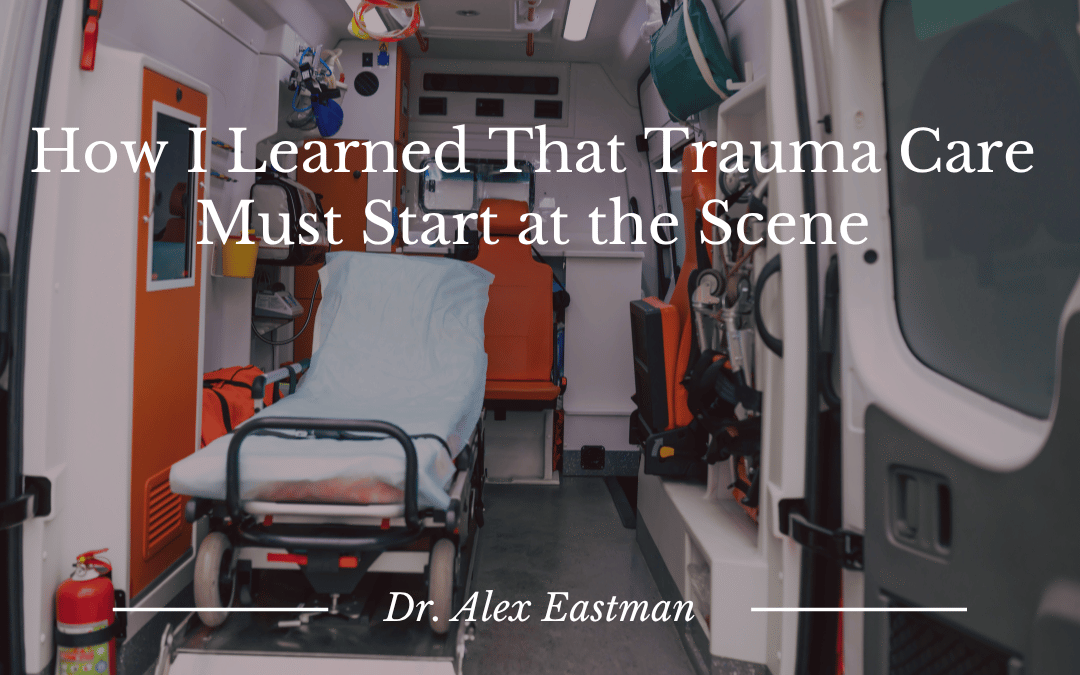
I have come to believe something very simple over the years. Trauma care has to start at the scene.
That may sound obvious. It is. Still, I think people sometimes talk about trauma as if the real work starts when a patient reaches the hospital. I have never seen it that way.
By the time a patient gets to us, a lot has already happened. Or at least, it should have. Someone called 911. Someone sized up the situation. Someone made early decisions. In many cases, someone controlled bleeding, protected an airway, or helped move a patient toward definitive care. Those early minutes matter. They are not separate from trauma care. They are trauma care.
That is one reason I have always cared so much about what happens before the handoff. A smooth transition into the hospital matters, of course, and I have written about that in Smooth Handoffs That Improve Outcomes. But even the best handoff cannot make up for lost time at the beginning.
I think that is the part people outside trauma sometimes miss. There is no pause button. Injury does not wait for the hospital team to get ready. The process begins immediately. So the response has to begin immediately too.
In my mind, that is what good trauma systems understand. They do not separate the scene from the trauma bay as if one matters less than the other. They treat the whole thing as connected. The bystander matters. The firefighter matters. The EMT and paramedic matter. The nurse matters. The surgeon matters. Every step affects the next one.
I have seen how strong systems work, and I have seen how much depends on the first few decisions. Sometimes progress looks dramatic. More often, it looks quiet. Someone notices severe bleeding and acts fast. Someone keeps the scene organized. Someone gets the patient where they need to go without wasting precious time. That quiet work is easy to overlook, but it saves lives. I touched on that in The Quiet Work Behind Trauma Care because I do not think it gets enough attention.
I also think we have done a better job in recent years of helping the public understand that they have a role too.
That matters to me.
People do not need to be trauma professionals to make a real difference. In some emergencies, the person standing nearby is the first link in the chain. That is especially true when severe bleeding is involved. Direct pressure matters. Wound packing matters. Tourniquets matter. Used correctly, those tools buy time, and in trauma, time is everything. I wrote more about that in Tourniquet Myths and Safe Use in Everyday Emergencies because I still hear too much hesitation around something that can be lifesaving.
Maybe that is the core of this whole idea. Trauma care is not just a hospital function. It is a shared effort. It starts where the injury happens and keeps going from there.
That perspective has shaped how I think about field response, hospital response, and the people who work in between. It has also shaped how I think about law enforcement and tactical medicine. Different settings bring different demands, but the principle stays the same. The scene matters. The first actions matter. The early decisions matter. There is more on that in Dallas SWAT Missions and Dallas Police Reserve Officer of the Year.
I am not saying hospitals matter less. They matter enormously. Neither am I suggesting that scene care alone determines the outcome. Trauma is more complicated than that. But I do think we sometimes underestimate how much of the outcome starts taking shape before the patient ever reaches the door.
That is why I keep coming back to this point. Trauma care must start at the scene, because that is where the problem begins. Waiting to think seriously about care until the hospital takes over is just too late.
And if you work around trauma long enough, it becomes hard to see it any other way.
For those interested in the broader practical side of trauma systems, I also recommend the Parkland Trauma Handbook, Third Edition.
Disclaimer: This piece reflects my personal views and is not medical advice.